
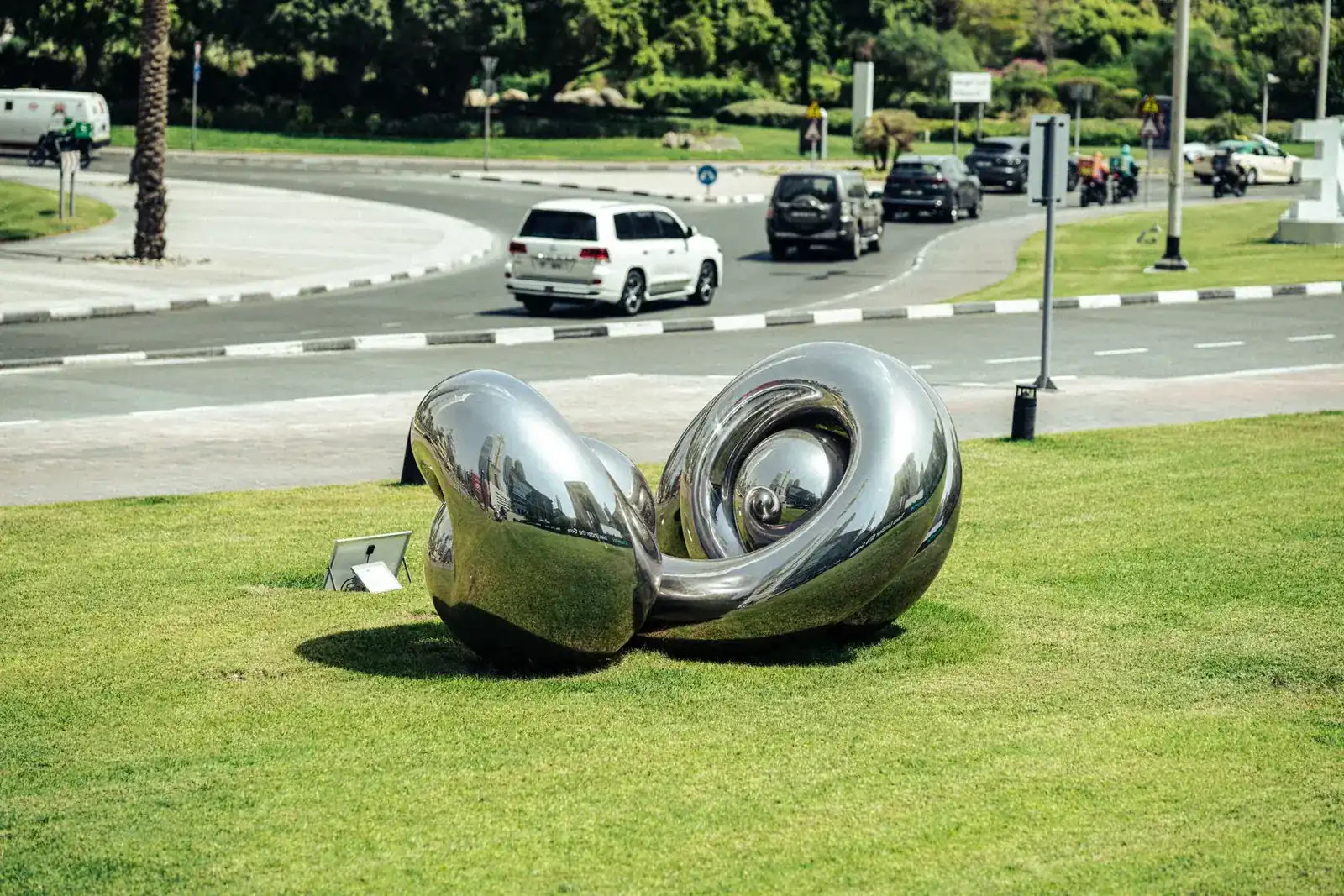
Renewable energy art covers two distinct approaches. Some works use energy as a visual medium, turning wind or sunlight into motion and light. Others are designed as working generators in sculptural form, producing electricity for the site or the grid. This article focuses on the second group: installations meant to produce power, and what is actually known about their output.
The distinction matters because “energy art” can mean art about energy or art that makes energy. Only a small subset of projects contributes to electricity supply, and many quoted figures are design estimates for works that have never been built.
How it works
Renewable energy art builds standard generation technology into sculptural forms. Solar art uses photovoltaic cells or concentrated solar power (CSP). Wind art can use small turbines, aeroelastic flutter devices or rotors arranged in artistic patterns. Some projects combine sources: WindNest, for example, was designed to generate from both wind and sun.
The key difference from a conventional power plant is the design priority. In a utility-scale wind farm, efficiency and cost per kilowatt-hour drive the engineering. In renewable energy art, visual impact and public engagement come first, and generation is a secondary, if functional, output. Where form comes first, output is likely to be lower than a conventional installation of similar cost.
Real-world examples
Land Art Generator Initiative (LAGI)
The Land Art Generator Initiative (LAGI), founded in 2008 by Elizabeth Monoian and Robert Ferry, is the best-known organised effort in this field. Its open design competitions, held since 2010, require entries to be public art that also generates clean energy at utility scale. Each entry states an estimated annual capacity, not measured output. LAGI says it has received nearly 2,000 designs from more than eighty countries.
The Solar Hourglass (2014) The winner of LAGI’s 2014 Copenhagen competition, The Solar Hourglass by Santiago Muros Cortés, is a concentrated solar power design. Heliostats (sun-tracking mirrors) in an upper dish direct light to a central reflector, which beams concentrated heat down to a lower dish. Its estimated annual capacity of 7,500 MWh is a figure for an unbuilt design: we found no evidence the structure has been built. It won a $15,000 prize from about 300 entries and remains a proposal for a former shipyard site in Copenhagen harbour.
WindNest (2022) In the UK, WindNest by artist and landscape architect Trevor Lee is the clearest built example. First designed for LAGI’s 2010 Abu Dhabi competition, it was installed at full scale in September 2022 on SEE MONSTER, a decommissioned North Sea offshore platform turned public artwork at the Tropicana in Weston-super-Mare. LAGI says its two rotating pods are designed to generate electricity from wind and sun for SEE MONSTER’s operations, including irrigation for its Garden Lab. LAGI lists an annual capacity of 30 MWh, but this is a design figure and no measured output has been published. LAGI’s own post said the solar part was “not yet fully realised” at installation, although an industry awards write-up described both wind and solar as operating.
Other LAGI projects
- Wind Forest (Glasgow, 2016): the winner of the LAGI Glasgow call, by Dalziel + Scullion and partners, combines a new wind technology with an ecological artwork and city park. We found no evidence it has been built.
- Arch of Time (Houston): Riccardo Mariano’s design from the 2019 Abu Dhabi competition was selected by the City of Houston through a public process. LAGI gives a planned output of 400,000 kWh (400 MWh) a year. It is described as being advanced, not as built.
- Choose Earth (Jackson, Wyoming): a solar mural that LAGI says produces about 2,500 kWh of solar electricity a year.
Olafur Eliasson and Little Sun
Little Sun, founded in 2012 by artist Olafur Eliasson and engineer Frederik Ottesen, is a product rather than a static installation: a small solar lamp. It was launched at Tate Modern on 28 July 2012 as part of the London 2012 Festival. The launch cited a 2012 figure of about 1.6 billion people living without mains electricity. The maker said five hours of sun charging gives about five hours of light.
Little Sun now says it has provided over 1 million personal solar devices. It also reports over 200 million extra study hours and more than $200 million in household savings; these are the organisation’s own, unaudited figures. It launched a Community Energy Hub in Chibombo, Zambia, in 2024, and since 2025 says it focuses exclusively on solar-powered agricultural productivity, mainly in Zambia.
Eliasson’s Ice Watch (with geologist Minik Rosing) is a different kind of work. From 11 to 20 December 2018, timed to the COP24 climate talks, it placed 24 blocks of Greenland ice in a clock formation outside Tate Modern. It is art about climate change; it did not generate electricity.
Daan Roosegaarde and Patrick Marold
Daan Roosegaarde’s Windlicht (2016), at Eneco’s wind farm in Sint Annaland, Zeeland, uses software and tracking to synchronise LED lights with the turning blades. It celebrates wind power visually; no generation figure is attributed to the artwork itself. His Smog Free Tower (first shown in Rotterdam in 2015) is an air-quality artwork: the studio says it cleans 30,000 m³ of air an hour using 1,170 W of green electricity.
Patrick Marold’s Windmill Project (2007) installed up to about 2,700 small windmills on a hillside above the Vail Golf Course in Colorado, lighting up when the wind exceeded about 5 mph. Each rotor drives a small generator powering its own LED. These works are self-powered visualisations of wind and do not export power to the grid.
Ned Kahn’s wind façades and Anthony Howe’s kinetic sculptures are often grouped with renewable energy art, but they are wind-driven motion, not generators. Kahn’s wind wall at Centene Plaza in Clayton, Missouri, is described as 93,000 aluminium flappers that move in the wind; we found no source saying either artist’s works generate electricity.
What the numbers say
Most output figures for renewable energy art are design estimates rather than measured data.
- WindNest: LAGI lists an annual capacity of 30 MWh, but no measured output has been published.
- The wind tree: the Arbre à Vent by French company NewWind is a cautionary tale. NewWind went into receivership in December 2016 and was liquidated on 8 March 2017. A commonly quoted maker figure is about 2,400 kWh a year per tree. A 2026 German report on a privately owned 10-metre tree in Lower Saxony found it averaged about 1.8 kWh a day in moderate wind, against a theoretical 10.8 kWh a day. By our estimate that is roughly 650 kWh a year. At a cost of about €70,000, the report noted it would practically never pay for itself.
- Little Sun: its impact figures (200 million study hours) are the organisation’s own claims and relate to small, distributed lamps, not grid-scale power.
The wind tree is the clearest measured case of a sculptural generator delivering far less than claimed. A turbine shaped for looks, in low, turbulent urban wind, will have a poor capacity factor.
Limitations / honest assessment
Renewable energy art is not a meaningful source of electricity. Built outputs are small relative to national demand, and where costs are known, as with the wind tree, the cost per unit of electricity is very high compared with conventional solar energy or wind installations.
Independent verification is also thin: most LAGI capacity figures are for unbuilt designs, Little Sun’s impact statistics are unaudited, and the one independent wind tree measurement came in well below the maker’s figure.
We found no source defining an “energy art movement” as a formal art-historical movement; the field is better described as an overlap between engineering, landscape design and public art. Projects such as LAGI aim to make renewable infrastructure more acceptable to the communities that live with it, but we found no study measuring whether renewable energy art changes public attitudes or policy.
The UK angle
The UK’s links to this field are mostly temporary or unbuilt.
- WindNest: installed on SEE MONSTER in Weston-super-Mare in September 2022. The platform opened as part of UNBOXED: Creativity in the UK. LAGI calls WindNest the first full-scale built outcome of one of its design competitions, and said afterwards it would find a permanent home in Weston-super-Mare; we could not confirm where it is now.
- LAGI Glasgow: an open call in August 2015 drew twelve joint teams. Wind Forest was announced as the winner on 9 June 2016 for the Port Dundas / Dundas Hill regeneration area. ecoartscotland and LAGI won the 2016 CIWEM Arts, Water and Environment Award, but we found no evidence the design has been built.
- Tate Modern: the 2012 Little Sun launch used “Tate Blackouts” to draw attention to people living without mains electricity.
For art that people power themselves, see our piece on energy-generating playgrounds.
Frequently asked questions
What is renewable energy art?
The term covers two types of work: art that visualises energy, such as wind-driven sculptures, and art designed to generate electricity, such as LAGI’s competition entries or WindNest.
Do renewable energy sculptures actually generate useful electricity?
Some generate a little, but rarely much. WindNest has a design capacity of 30 MWh a year, with no measured output published. The one independently measured wind tree produced far less than its theoretical output.
What is the Land Art Generator Initiative?
Founded in 2008 by Elizabeth Monoian and Robert Ferry, LAGI runs design competitions for public art that also generates clean energy. It says it has received nearly 2,000 designs from more than 80 countries.
Are there renewable energy artworks in the UK?
Yes, a few. WindNest was installed on SEE MONSTER in Weston-super-Mare in 2022. Wind Forest won LAGI Glasgow in 2016 but we found no evidence it has been built. Olafur Eliasson’s Little Sun was launched at Tate Modern in 2012.
What happened to the “wind tree” turbine, and how much power does it make?
Its French maker, NewWind, was liquidated in March 2017. A 2026 German report found a private wind tree averaged about 1.8 kWh a day, roughly 650 kWh a year by our estimate, against a commonly quoted maker figure of about 2,400 kWh.
Is “energy art” an art movement?
No. We found no source defining an “energy art movement” as a formal art-historical movement. The term is used loosely.