
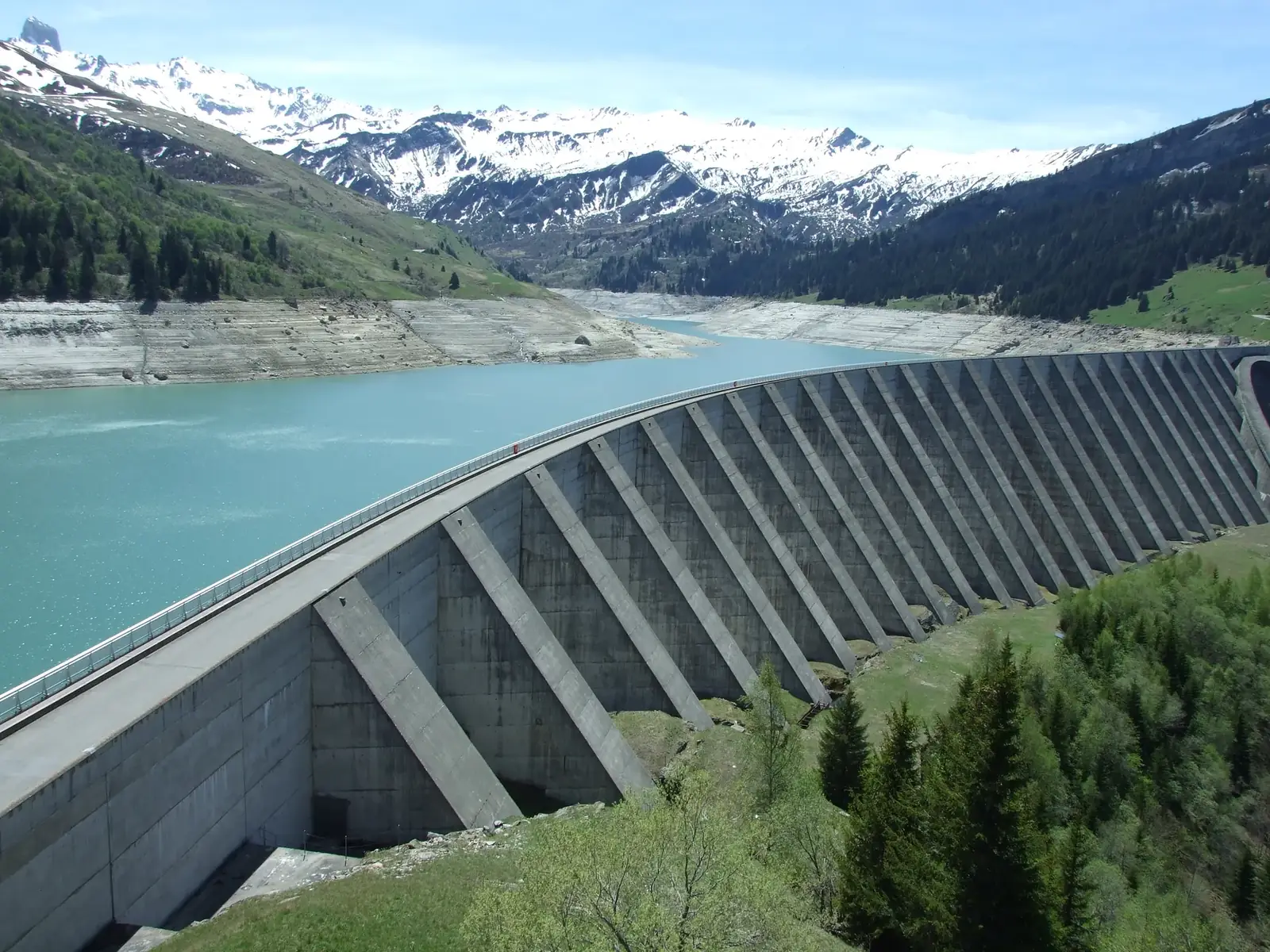
Pumped storage hydropower is a large-scale energy storage system that functions like a giant battery. It stores electricity by pumping water uphill to a reservoir when power is cheap or in surplus, then releases it back through turbines to generate electricity when demand peaks. This mechanism provides the grid with fast-acting reserve capacity and helps balance the variable output of wind and solar power.
Unlike primary generation sources, pumped storage is a net consumer of electricity. It does not create energy; it stores it. This distinction is crucial when evaluating its role in a decarbonised grid. Pumped storage is a form of gravity energy storage, using water as the mass, and it remains one of the few proven options for long-duration energy storage that can discharge for many hours.
How it works
A pumped storage hydropower plant relies on two reservoirs at different elevations. The system operates in two distinct phases: charging and discharging.
When electricity is abundant and prices are low—often during periods of high wind generation or low overall demand—reversible pump-turbines act as pumps. They move water from a lower reservoir to an upper reservoir, effectively storing energy as gravitational potential energy.
When electricity demand spikes, the process reverses. Water flows from the upper reservoir down through the same machines, which now function as turbines and generators. This converts the potential energy back into electrical energy, which is fed into the grid. Conventional hydropower shares similar principles, but pumped storage adds the critical element of rechargeable storage.
The storage duration is determined by the size of the reservoirs. Ffestiniog can run for about four hours at full output, Cruachan for about 15 hours, and the planned Coire Glas scheme for more than a day. Ofgem defines long-duration electricity storage (LDES) for its support scheme as storage capable of discharging for eight hours or more, a category into which many pumped storage schemes fit.
Real-world examples
The UK’s current fleet of operating pumped storage stations is concentrated in Wales and Scotland. These facilities have provided grid stability for decades, though no new large station has been built since 1984.
Dinorwig (Llanberis, Wales) Known as “Electric Mountain”, Dinorwig is the UK’s largest pumped storage station. It opened in 1984 after construction began in 1974. The plant has a maximum output of 1,728 MW and holds approximately 9.1 GWh of storage. It is owned by First Hydro Company, a joint venture between Engie (75%) and CDPQ (25%). Dinorwig can reach full output in about 16 seconds when its units are already spinning in air, and one unit takes about 75 seconds from a standstill.
Ffestiniog (Blaenau Ffestiniog, Wales) Commissioned in 1963, Ffestiniog was the UK’s first major pumped storage station. It has a capacity of 360 MW (four 90 MW units) and approximately 1.44 GWh of storage, allowing it to discharge for roughly four hours at full output. It is also owned by First Hydro Company. Engie and CDPQ have announced plans to invest up to £1 billion in Dinorwig and Ffestiniog. As of May 2025, two of Ffestiniog’s four units had been rebuilt, with the remaining two due by the end of 2025; replanting Dinorwig’s units had not yet reached a final investment decision.
Cruachan (Loch Awe, Scotland) Often referred to as the “Hollow Mountain”, Cruachan has its turbine hall about 1 km inside Ben Cruachan. It has a capacity of 440 MW and can run at full output for about 15 hours, storing approximately 7 GWh. The plant uses a head of 396 metres. It was acquired by Drax in December 2018. In September 2022, Drax announced plans to upgrade two units from 100 MW to 120 MW each, raising total capacity to 480 MW in an £80 million programme.
Foyers (Loch Ness, Scotland) Foyers opened in April 1975 and has a capacity of 300 MW (two 150 MW reversible units). It uses Loch Mhòr as an upper reservoir and Loch Ness as the lower reservoir. When spinning in air, it can generate power in just 30 seconds, taking under two minutes from a standstill. It is owned by SSE.
Coire Glas (Loch Lochy, Scotland) Located between Fort William and Inverness, Coire Glas is SSE’s proposed new station. It is planned at about 1.4 GW (listed by Ofgem at 1,440 MW and 32 hours), storing at least 45 GWh, according to SSE. The upper reservoir could hold up to 40 billion litres of water. The scheme was first consented in 2013, with an updated consent in 2020. SSE has spent over £100 million on development, including a 1.2 km exploratory tunnel completed in August 2024. It was on Ofgem’s provisional “minded-to” list in June 2026, but there is no final investment decision; SSE says any decision will depend on its capital discipline and return thresholds.
Earba (River Spean catchment, Scotland) Gilkes Energy’s Earba scheme proposes 1,800 MW with 40 GWh of storage, according to the developer (Ofgem’s list gives a 15-hour duration, which does not match). It received Section 36 consent in March 2025 and is also on Ofgem’s provisional support list. No final investment decision has been announced.
Loch Kemp Storage (Dell Estate, near Loch Ness) Proposed by Statera Energy, this scheme is described by the developer as up to 600 MW; Ofgem’s list gives 660 MW and 22.3 hours of storage. It was on the June 2026 Ofgem minded-to list. We could not confirm whether its Section 36 consent has been granted as of October 2026.
What the numbers say
Pumped storage is not perfectly efficient. It consumes more electricity to pump water uphill than it generates when the water flows back down.
Efficiency The US Energy Information Administration reported that the US fleet achieved an average monthly round-trip efficiency of 79% in 2019. This compares to 82% for utility-scale batteries. Literature reviews suggest a broader efficiency range of 70% to 87%. Dinorwig’s average efficiency is reported at 74–76%.
Speed Speed is a key advantage. Dinorwig can go from zero to full output in about 16 seconds (if spinning) or about 75 seconds for one unit (from standstill). Foyers can generate in 30 seconds when spinning, and under two minutes from standstill. Engie says Dinorwig can supply 1,728 MW within 12 seconds, so sources vary on the exact timing.
Capacity and Global Scale Globally, pumped storage capacity surpassed 200 GW for the first time in 2025, reaching approximately 201 GW. In 2025 alone, a record 11.7 GW of new pumped storage was added. China accounted for over 40% of global capacity additions that year and has 218 GW of pumped storage under construction. The global development pipeline includes 1,127 GW of hydropower, of which 621 GW is pumped storage.
UK Capacity The UK currently has 2.8 GW of long-duration electricity storage, all of which is pumped storage hydro, spread across four schemes in Scotland and Wales. No new large station has been added since Dinorwig opened in 1984.
Costs and Investment First Hydro Company’s owners plan to invest up to £1 billion in refurbishing Dinorwig and Ffestiniog. Drax’s Cruachan upgrade is an £80 million programme. SSE has spent over £100 million developing the Coire Glas project.
Limitations / honest assessment
Pumped storage is not a universal solution. It requires specific geography: a significant height difference between reservoirs and access to water. The UK’s new schemes are concentrated in the Scottish Highlands and North Wales.
High Capital Costs and Long Lead Times Building a new pumped storage station is expensive and time-consuming. Coire Glas was first consented in 2013 and still has no final investment decision. The high upfront capital costs mean that projects, even with consent, are reluctant to commit without government support. Drax, for example, decided in May 2025 not to bid into Ofgem’s first support window for its consented 600 MW Cruachan II expansion, citing rising projected costs and unclear capital recovery; the project is on hold.
Environmental Impact Large reservoirs, dams and tunnels alter local ecosystems and landscapes. These projects also require significant land use, which can affect local communities.
Efficiency Limits With round-trip efficiencies typically below 80%, pumped storage loses energy during each cycle, and slightly more than utility-scale batteries do. Its strengths are scale and duration rather than efficiency.
The “Battery” Misnomer Calling pumped storage a “battery” is useful for understanding but technically inaccurate. A battery stores chemical energy; pumped storage stores gravitational potential energy. Pumped storage plants also have very long asset lives: Wales’s First Minister said in 2025 that the First Hydro refurbishment should keep the Welsh plants running for another 25 years, on top of the decades they have already operated.
The UK angle
The UK has been slow to build new pumped storage. No new large station has been built since 1984. However, the landscape is shifting. The British Hydropower Association reported 11 schemes in development in 2025, totalling approximately 10 GW and 200 GWh.
Ofgem’s Cap-and-Floor Scheme To accelerate development, Ofgem opened the first application window of its cap-and-floor scheme for long-duration electricity storage in April 2025. This mechanism provides a minimum revenue floor (topped up by consumers if revenue falls below it) and a maximum revenue cap (revenue above it returned to consumers). It is modelled on the interconnector regime.
On 26 June 2026, Ofgem published a provisional “minded-to” decision for Window 1, covering 16 projects and 7,645 MW. Three pumped storage projects were included: Loch Kemp, Coire Glas, and Earba, alongside 11 lithium-ion batteries, one compressed air scheme and one flow battery. Ofgem expects to publish a final decision later in autumn 2026; none had been published as of early October 2026, and no UK pumped storage project has yet reached a final investment decision. Government analysis cited by Ofgem estimated that 20 GW of long-duration storage could save the system £24 billion between 2030 and 2050.
Future Pipeline Beyond the three projects mentioned, other schemes like Fearna/Glen Earrach (1.8–2 GW) and Balliemeanoch (1.5 GW) were at various stages of consent or development in 2025, and none is on Ofgem’s June 2026 list. In July 2026, SSE announced consent for upgrades at Sloy that give it the option, not a commitment, to convert the existing station to pumped storage with up to 16 GWh of storage; Sloy is not on the Ofgem list either.
Pumped storage hydropower remains the UK’s only large-scale long-duration storage today. It cannot solve all storage needs, but its scale, duration and rapid response give it a central role in a renewable-heavy grid. For more on how other technologies fit into this mix, see the environmental impact of battery technologies.
Frequently asked questions
What is pumped storage hydropower and how does it work?
Pumped storage hydropower is a method of storing energy by moving water between two reservoirs at different heights. When electricity is cheap or surplus, water is pumped uphill. When demand is high, water is released downhill through turbines to generate electricity. It is not a primary energy source but a storage system.
How efficient is pumped storage?
Pumped storage is not 100% efficient. The US fleet averaged 79% round-trip efficiency in 2019, while literature suggests a range of 70–87%. Dinorwig’s average efficiency is reported at 74–76%. This means some energy is lost during the pumping and generation cycle.
How many pumped storage stations are there in the UK and how big are they?
The UK has four operating pumped storage stations with a total capacity of about 2.8 GW. These are Dinorwig (1,728 MW), Ffestiniog (360 MW), Cruachan (440 MW), and Foyers (300 MW). All are located in Wales and Scotland.
Is the UK building new pumped storage?
Not yet at construction stage. Coire Glas (about 1.4 GW), Earba (1.8 GW) and Loch Kemp received provisional support in Ofgem’s June 2026 minded-to decision, but that decision is not final and none of the projects has a final investment decision. No new large station has been built since 1984.
How much pumped storage is there worldwide?
Global pumped storage capacity surpassed 200 GW in 2025. In that year alone, a record 11.7 GW of new capacity was added. China leads development, with over 40% of global additions in 2025 and 218 GW of pumped storage under construction.
What is Ofgem’s cap and floor scheme for long-duration storage?
Opened to applications in April 2025, this scheme supports long-duration electricity storage projects. It provides a revenue floor that consumers top up if a project’s revenue falls too low, and a revenue cap above which revenue is returned to consumers. Its first provisional list, in June 2026, included pumped storage, compressed air, a flow battery and lithium-ion batteries; the final decision is expected later in autumn 2026.