
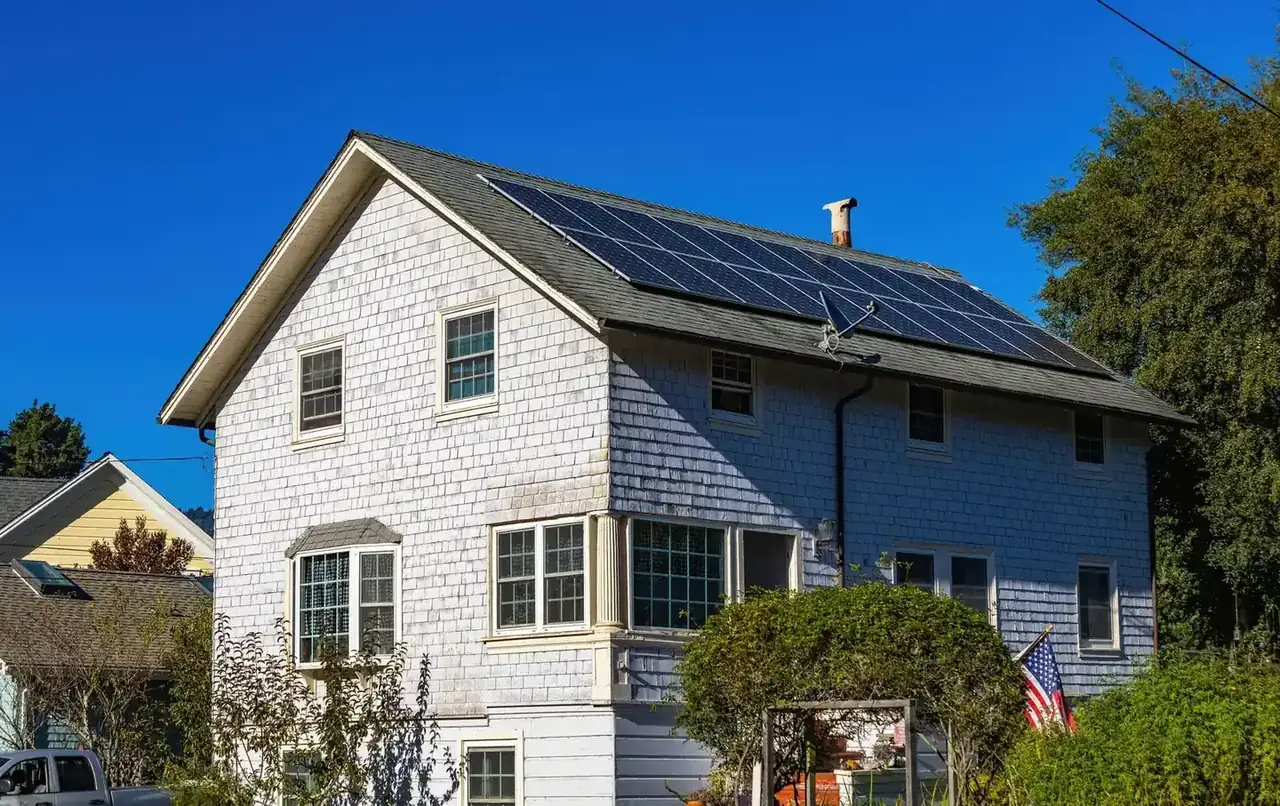
Solar panels for home use are now a common sight on British roofs. Government figures (DESNZ) count 1,761,110 domestic installations at the end of August 2026, with more than 195,000 homes adding solar in the 12 months to August 2026. The Energy Saving Trust (EST) puts the installed cost of an average 4.5 kWp system at around £7,600 (2026), and how long it takes to pay for itself depends on where you live, when you use electricity and the export tariff you get.
This guide covers costs, output by region, batteries, plug-in solar and the August 2026 planning changes. It is general information, not advice: check current scheme rules on GOV.UK and use MCS-certified installers.
How solar panels work
Solar panels turn sunlight into direct current (DC) electricity. An inverter converts this into alternating current (AC), which household appliances use. EST notes that cells do not need direct sunlight and can still work on cloudy days, though output is lower.
A typical home system has three parts: the panels on the roof, an inverter and an optional battery. Electricity you do not use in the house or store in a battery goes to the grid, and you can be paid for it through the Smart Export Guarantee (SEG).
If part of your roof is shaded by trees or neighbouring buildings, optimisers can stop one shaded panel dragging down the rest. On an unshaded roof, EST says, optimisers will not increase output, although they add monitoring.
Every installation must be registered with the Distribution Network Operator (DNO), usually by the installer; in Northern Ireland this is NIE Networks. Panels can also go on a flat roof, a garden frame, or a shed or garage, provided the roof is strong enough.
The real-world numbers: costs and generation
EST says the average home system is around 4.5 kWp, covers 20 to 30 square metres of roof and uses around 12 panels, at an installed cost of around £7,600. Government cost data from the Department for Energy Security and Net Zero (DESNZ), drawn from the MCS database, gives a more detailed picture.
For the financial year April 2025 to March 2026, the median cost for 4–10 kW systems was £1,546 per kW, and for 0–4 kW systems £1,595 per kW. On our arithmetic, a 4 kWp system comes to about £6,200 at the 4–10 kW median and about £7,200 at the 0–4 kW mean (£1,808 per kW). These figures include VAT where applicable and exclude batteries.
Real-terms median costs fell by 7% for 0–4 kW systems and 9% for 4–10 kW systems compared with 2024/25. The 2025/26 analysis covered a record 264,742 installations. Your own quote will depend on system size, roof access and whether the roof needs work.
How much power will you generate?
Output varies by region and weather. The European Commission’s PVGIS tool estimates annual output per kWp at optimal tilt:
- London: about 1,020 kWh per kWp
- Manchester: about 890 kWh per kWp
- Edinburgh: about 910 kWh per kWp
- Plymouth: about 1,120 kWh per kWp
These are best-case figures. Across real UK systems, average output was about 805 kWh per kW in 2024 (the least sunny year in the series) and about 970 kWh per kW in 2025 (the sunniest), based on government capacity factor data. On the PVGIS figures, a south-facing 4 kWp system at optimal tilt would produce roughly 3,500 to 4,500 kWh a year, depending on region.
Generation is also strongly seasonal. National solar output was 8.4 TWh in Q2 2026, against 2.1 TWh in Q4 2025.
Self-consumption: do you need a battery?
Self-consumption is the share of the electricity your panels generate that you use in the home. EST points out that most people are not at home in the middle of the day, when output peaks.
MCS guidance (2019 modelling) gives worked examples rather than predictions for a particular home. A home-all-day household reached 29% self-consumption without a battery and 69% with a 7.5 kWh battery. An in-half-the-day household went from 39% to 88% with a 5.1 kWh battery.
Because export usually pays less than imported electricity costs, using your own power is generally worth more. EST says export typically earns around 12p a unit, while you would normally buy electricity for more than twice that.
Batteries are optional. They are most useful if you want to use more of your own power or charge from the grid on cheap time-of-use rates. EST gives two cost ranges on two pages: around £5,000 to £8,000 on its solar page, and £1,500 to £10,000 on its battery page, where a 5 kWh system costs around £4,600 (both 2026). EST puts typical battery lifespan at about 10 to 12 years, so a battery will need replacing before the panels.
Is it worth it? The payback period
Savings depend on your home, usage, fuel prices and the export rate you secure. EST’s payback periods for a typical system, including export payments and using July 2026 fuel prices, are:
- London: 9 years (all occupancy types)
- Manchester: 10–11 years
- Aberystwyth: 9–10 years
- Stirling: 11–12 years
EST has not yet published Northern Ireland figures.
A government estimate from June 2025 suggested a typical existing home with a 3.5 kW south-facing system could save around £530 a year at April 2025 price-cap rates. In one EST case study (a single household, not typical), a Somerset couple with 18 panels powering a heat pump and an EV charger say they save around £750 a year.
EST research published in July 2026 found that combining heat pumps, solar, batteries and time-of-use tariffs can save up to around £800 a year. EST also says a typical home system could save around one tonne of carbon a year.
The Smart Export Guarantee (SEG)
The SEG has run in Great Britain since 1 January 2020. Energy suppliers with at least 150,000 domestic customers must offer an SEG tariff. Rates must be above zero, but suppliers set their own rates and terms. For solar up to 50 kW, proof of eligibility is normally an MCS certificate.
In Northern Ireland the SEG does not apply; EST advises asking your supplier whether it offers an export tariff.
Export rates vary widely. The Solar Energy UK league table (May 2026) shows rates from 1p to 25p per kWh. Most untied tariffs pay 1p to 6p, for example ScottishPower SmartGen 6p, E.ON Next Flex Export 6p and Octopus SEG 4.1p. The 15p to 25p tariffs are tied to the supplier’s import tariff or equipment. In SEG Year 5 (April 2024 to March 2025), Ofgem reports the average tied tariff paid 14.54p/kWh and the average untied tariff 4.39p/kWh. For other support, see our guide to solar energy policies and incentives.
Recent changes and legal updates
VAT
Solar panels installed in homes are zero-rated for VAT until 31 March 2027. From 1 April 2027 the rate reverts to 5%. Since 1 February 2024 home batteries, including those added to existing solar, also qualify for the zero rate until the same date.
Planning permission
In England, most rooftop solar on houses is permitted development. Rules updated on 27 August 2026 set these limits, although the old rules can still be used until 26 August 2027:
- Pitched roofs: panels can protrude no more than 0.2 metres from the roof slope and cannot sit above the highest part of the roof (excluding chimneys).
- Flat roofs: panels can be no more than 0.6 metres above the highest part of the roof.
- Ground-mounted: panel area is limited to 9 square metres, with height limits of 1 to 4 metres depending on position and distance from the boundary.
- Conservation areas and World Heritage Sites: panels cannot go on a wall, balcony or roof enclosure fronting a highway. Permitted development does not cover listed dwellings.
Scotland, Wales and Northern Ireland have their own rules, so check locally.
Plug-in solar
Plug-in (balcony) solar became legal in Great Britain on 27 August 2026, capped at 800 W AC. The interim product rules allow one device per ring circuit and no extension leads or multi-way adaptors. EST says systems cost from around £450 and an 800 W system produces around 700 kWh a year, which could save about £100 a year if someone is home all day, or £70 if out during the day (based on its Manchester assumptions). Plug-in kits normally cannot earn SEG payments, because suppliers require an MCS certificate. Northern Ireland may follow once regulations are updated.
Warm Homes Loan Scheme
The Warm Homes Loan Scheme is launching from September 2026, with loans of up to £15,000 each for solar PV and batteries. We could not confirm which lenders are offering products, so check GOV.UK. It will not fund roofing or structural work before solar is installed.
Limitations and honest assessment
Output varies year by year with the weather. An NREL review of international field data found a median degradation of 0.5% a year; as illustrative arithmetic, at that rate a panel would produce roughly 88% of its original output after 25 years. EST says panels should last 25 years or more, but inverters typically need replacing after around 12 years.
Roof suitability matters. An unshaded, south-facing roof is ideal; EST says east- or west-facing roofs get around 15–20% less energy, and it does not recommend north-facing roofs. For the bigger picture on solar power, see our solar energy explainer or the live GB electricity mix.
Frequently asked questions
How much do solar panels cost for a typical UK home in 2026, and how long do they take to pay back?
EST puts an average 4.5 kWp system at around £7,600 (2026). Its payback estimates range from 9 to 12 years in England, Scotland and Wales at July 2026 fuel prices, depending on location and when you are at home. Your own figures will depend on your home, usage and tariff.
How much electricity will a 4 kWp system generate where I live?
On PVGIS best-case estimates at optimal tilt, a 4 kWp system would produce roughly 4,080 kWh a year in London, 3,560 kWh in Manchester and 4,480 kWh in Plymouth. Real-world output is usually lower and varies with the weather from year to year.
How much of my solar electricity will I actually use, and is a battery worth it?
In MCS worked examples, households used 29% to 39% of their solar output without a battery and 69% to 88% with one. A battery can help if you want to use more of your own power or charge on cheap time-of-use rates, but EST quotes costs of £5,000 to £8,000 on one page and £1,500 to £10,000 on another, and it will likely need replacing before the panels.
Do I need planning permission for solar panels, and what changed in August 2026?
Most rooftop solar on houses in England is permitted development. Rules in force from 27 August 2026 limit pitched-roof panels to 0.2 metres from the slope, flat-roof panels to 0.6 metres, and ground-mounted panels to 9 square metres; the old rules remain usable until 26 August 2027. Check with your local planning office if you live in a listed building, conservation area or national park, or outside England.
Are plug-in balcony solar panels legal now, and what can they save?
Yes, in Great Britain since 27 August 2026, capped at 800 W. EST estimates savings of about £100 a year if someone is home all day, or £70 if out during the day. They normally cannot earn Smart Export Guarantee payments.
How do I choose a trustworthy installer (MCS, RECC, HIES), and how long will panels last?
EST advises getting quotes from at least three MCS-certified installers. Under the Renewable Energy Consumer Code (RECC) you should not have to pay more than 25% of the contract price as a deposit, and high-pressure selling is restricted. HIES members work under an approved consumer code with deposit protection and insurance-backed guarantees. EST says panels should last 25 years or more, with inverters typically replaced after around 12 years.