
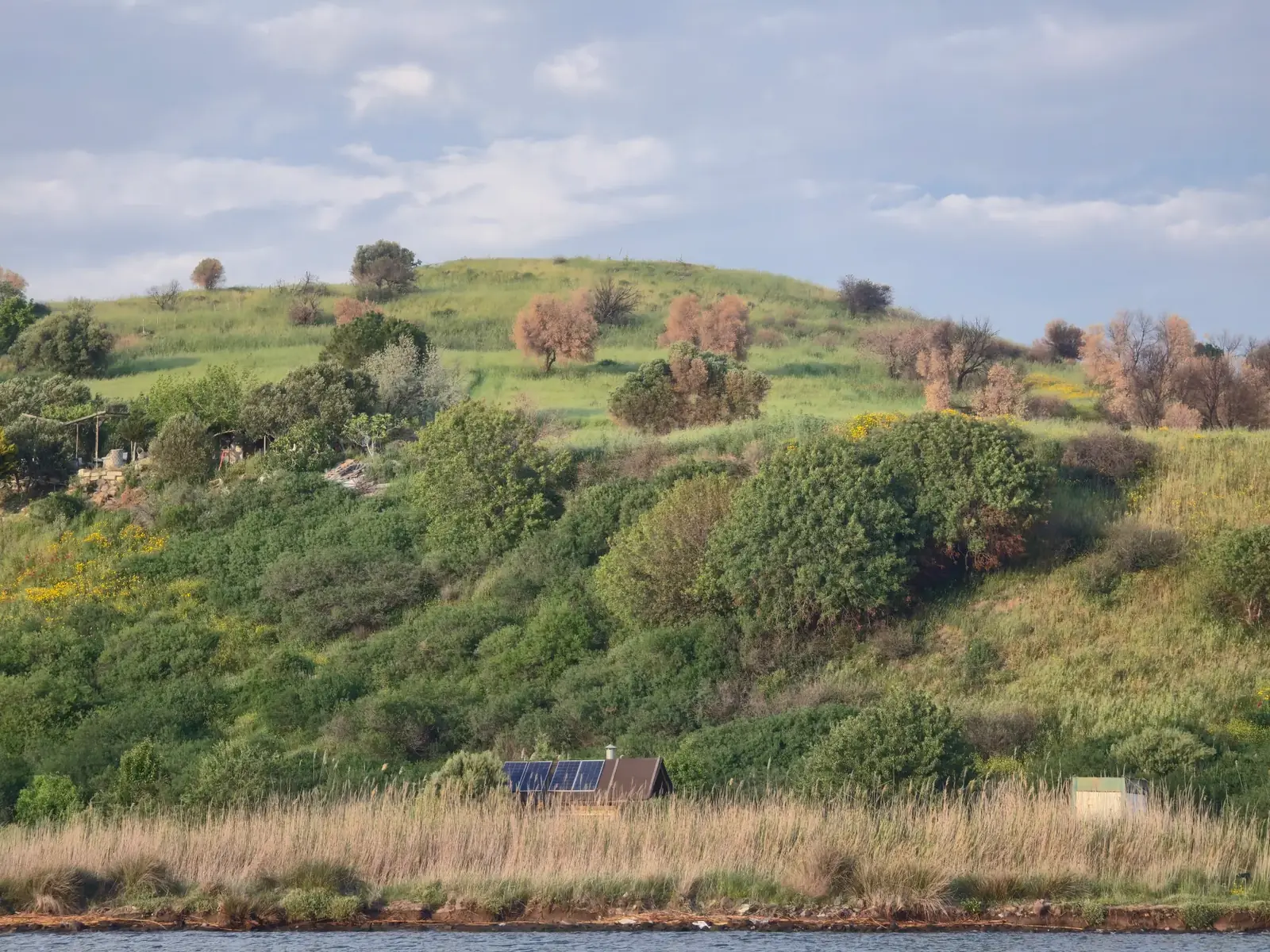
The short answer: yes for electricity, at a cost. Off-grid living in the UK is achievable for lights and appliances if you oversize your solar array and battery and keep a small generator for the darkest weeks. Heating is the hard part. By our modelling, covering winter heat from solar panels and batteries alone is not achievable at domestic scale.
Full independence, covering heat, water and waste too, is a lifestyle choice rather than a way to save money. This guide is general information, not financial advice: get quotes from MCS-certified installers and check GOV.UK for current scheme rules.
Start with the numbers: what a typical home uses
Ofgem’s typical domestic consumption values, in use from 1 July 2026, are 2,500 kWh of electricity and 9,500 kWh of gas a year. Under the price cap for 1 October to 31 December 2026 (direct debit, GB average), Ofgem puts the typical bill at £1,723 a year. Electricity costs 26.32p/kWh plus 54.83p a day, and gas costs 7.97p/kWh plus 29.68p a day. By our calculation, that is about £858 for electricity and £865 for gas.
Heat is the biggest job. Government figures (DESNZ, Energy Consumption in the UK 2026) show that in 2025, 60.8% of UK domestic energy went on space heating and 17.4% on water heating. That is about 78% of household energy.
Heat demand is also lopsided across the year. The UK’s 30-year mean is 10.59 heating degree days per day in January against 0.61 in July. By our calculation, January needs roughly 17 times as much space heating as July. For a typical gas-heated home that means about 1,350 kWh of gas in January against about 250 kWh in July.
The UK’s winter problem
Solar energy works well in a British summer, but output collapses in winter, just when heating demand peaks. The table shows PVGIS figures (the EU Joint Research Centre’s tool, 2005–2023 data) for 1 kWp of panels facing south at a 35° tilt:
| City | Output per year (kWh/kWp) | December (kWh) | June (kWh) | December as % of June |
|---|---|---|---|---|
| London | 1,019 | 36.3 | 122.6 | 30% |
| Birmingham | 968 | 33.1 | 117.0 | 28% |
| Manchester | 886 | 28.2 | 110.7 | 25% |
| Edinburgh | 903 | 22.2 | 110.9 | 20% |
Sunshine records tell the same story. The UK 20-year mean is 1.66 hours of sunshine a day in December against 6.53 in June (DESNZ, 2026).
Runs of dull days are the real difficulty. We built an hourly model on PVGIS data for Birmingham from 2014 to 2023. Its results are best-case estimates. Real winters will be worse, partly because PVGIS does not model snow on panels. By our estimate:
- In December and January, the median day gives 0.82 kWh per kWp. An average June day gives 3.9 kWh.
- 37% of those midwinter days give under 0.5 kWh per kWp.
- The worst seven days in a row gave just 1.3 kWh per kWp for the whole week.
- The longest run of days under 0.5 kWh per kWp between November and February was 15 days.
A 10 kWp array in Birmingham therefore gives about 10.7 kWh a day in an average December, but only about 13 kWh across its whole worst week. In our model, an all-electric home with a heat pump uses about 21 kWh a day in January, peaking at about 33 kWh.
That sets the battery size. On our calculation, three days of autonomy means roughly 50–65 kWh of usable storage for an all-electric home. For an electricity-only load of 2,500 kWh a year (about 6.8 kWh a day) it means about 20 kWh. To try different array and battery sizes for your own home, use our off-grid solar calculator. No battery can carry June’s surplus into December, because that would take seasonal storage, which is not practical in a home.
Wind helps a little. The UK mean wind speed is 10.2 knots in January against 7.5 in July (DESNZ). Wind power rises with the cube of wind speed, so we estimate roughly 2.5 times as much power is available in January. Treat that as indicative only, because every site differs.
Four levels of energy independence
Costs and self-sufficiency figures below are our own estimates for a typical semi in Birmingham. Solar is costed at the DESNZ median of £1,546 per kW for 4–10 kW systems (MCS data, 2025/26). Batteries are costed at £400–£800 per usable kWh installed, an indicative range from retail and comparison sites in 2026. Self-sufficiency comes from our hourly model and represents idealised upper bounds, not measured results.
a) Grid-connected but mostly self-powered
- What it includes: 6 kWp of solar, a 10 kWh battery, an air source heat pump replacing the gas boiler, a loft top-up, cavity wall insulation and a time-of-use tariff.
- Cost (our estimate): about £20,600–£24,600. That includes the heat pump at £12,000 (Energy Saving Trust typical cost, 2026), less the £7,500 Boiler Upgrade Scheme grant.
- Self-sufficiency: about 72% a year in our model, or about 86% with 10 kWp and 20 kWh. Reaching 80–90% needs more panels than a typical three-bed roof can hold.
- Running costs: our model imports about 1,271 kWh a year and exports about 2,261 kWh. We assume an export rate of 5–15p/kWh. On that basis, by our calculation, the net bill is about £196–£422 a year on the capped flat tariff, or about −£42 to £184 with all imports at a smart tariff’s off-peak rate. For example, one widely used EV tariff charged 7.6p/kWh overnight from 1 October 2026; rates vary by supplier and region.
- Payback (our estimate): about 12–19 years. That leaves out the boiler replacement you avoid, which would shorten it. It also leaves out battery wear and replacing the inverter, which EST says happens after about 12 years; both would lengthen it.
- What it does not solve: imports are concentrated in November to February.
b) Off-grid electricity with a backup generator (gas kept)
- What it includes: 10–12 kWp of solar, 20–40 kWh of lithium iron phosphate (LFP) battery, an off-grid inverter/charger and an automatic-start generator. Mains gas stays for heating.
- Cost (our estimate, 10 kWp and 20 kWh): about £28,600–£36,600. That includes a 6 kVA silenced diesel generator listed at £5,095, but not the off-grid inverter/charger and design, which we could not price reliably.
- Self-sufficiency: in our model the system fell short on about 16 days a year, leaving about 40 kWh for the generator. By our estimate a generator makes about 2.5 kWh per litre, so that is roughly 16 litres. At the road diesel price of 200.04p/litre (12 October 2026), it would cost about £32. Red diesel remains legal for generating electricity in non-commercial premises.
- Payback: not meaningful. Even before the inverter, the kit costs over 30 times the £858 annual electricity bill it replaces.
- What it does not solve: heat, and roof space. EST says a 4.5 kWp system covers 20–30 m² of roof, so on our estimate 10–12 kWp needs roughly 45–70 m². A typical semi’s roof will not fit that, and ground-mounted solar over 9 m² loses permitted development rights.
b2) All-electric off grid
- What it includes: 12 kWp of solar, a 30 kWh battery, an air source heat pump, fabric upgrades and a generator.
- Cost (our estimate): about £43,000–£55,000, before the inverter/charger, design and any extra cost of finding room for the panels.
- Self-sufficiency: about 91% from solar and battery in our model, assuming fabric work cuts space heating by 30%. Off grid, it ran short on about 66 days a year, with a longest run of 30 days. It needed about 440 kWh from the generator, roughly 175 litres. Even 16 kWp with 60 kWh still ran short on 24 days.
- Payback: not meaningful.
- What it does not solve: winter heating without a generator.
c) Fully autonomous, including heat and water
- What it includes: level b2 plus a pellet boiler (about £9,200, EST), solar thermal (about £5,300, EST), a borehole and sewage treatment, and possibly a 6 kW turbine (about £35,000, EST). Checkatrade (2026) puts a borehole of about 60 m with pump at £10,000–£16,000, which is indicative only.
- Cost (our estimate): roughly £67,000–£85,000 without a turbine, or up to about £120,000 with one. That is before the inverter, design and a treatment plant, which we have not priced.
- Self-sufficiency: depends on the site; we have not modelled it.
- What it does not solve: cost. It makes sense only for a rural plot with no grid connection, or a very expensive one, and it is not an investment case.
| Level | What it includes | Cost (our estimate) | Energy covered (our model, best case) | Payback (our estimate) |
|---|---|---|---|---|
| a) Grid-connected | 6 kWp solar, 10 kWh battery, heat pump, loft and cavity insulation, smart tariff | £20,600–£24,600 | About 72% (86% with 10 kWp + 20 kWh) | About 12–19 years |
| b) Off-grid electricity, gas kept | 10 kWp solar, 20 kWh battery, generator | £28,600–£36,600 before inverter | Electricity only; about 16 short days a year, generator covers about 40 kWh | Not meaningful |
| b2) All-electric off grid | 12 kWp solar, 30 kWh battery, heat pump, insulation, generator | £43,000–£55,000 before inverter | About 91%; about 66 short days, about 440 kWh from generator | Not meaningful |
| c) Fully autonomous | b2 plus pellet boiler, solar thermal, borehole, treatment, optional turbine | £67,000–£120,000 before inverter and treatment plant | Site-dependent; not modelled | Not an investment case |
Fabric first: insulation and why it shrinks every system
Every kilowatt-hour you do not need in January is one you do not have to generate or store. EST costs for GB in 2026 are:
- Loft insulation to 270 mm: £750 from scratch, or £600 from 120 mm.
- Cavity wall insulation: £2,200, which EST says pays back in five years or less.
- Solid wall insulation: £12,000 internal or £15,000 external.
- A-rated glazing for a semi: £4,800.
EST says about 33% of the heat in an uninsulated home is lost through the walls. In our model, cutting space heating by an assumed 30% lowers an all-electric home’s January load from about 21 to about 17 kWh a day. With 6 kWp and 10 kWh, it cuts annual grid imports from about 1,750 to about 1,270 kWh. For cheaper first steps, see how to save energy at home.
Wind, wood, water and hydrogen: the other options
Wind. EST (2026) puts a 6 kW pole-mounted turbine at about £35,000, saving about £650 a year in GB if well sited. In an EST field trial across 57 UK sites (2009), no urban or suburban building-mounted turbine produced more than 200 kWh a year. Free-standing turbines at exposed rural sites averaged a 19% load factor. EST recommends a mean wind speed of at least 5 m/s. Small-scale wind energy is an option only for exposed rural sites.
Wood. EST says biomass is likely to cost more to run than a modern condensing gas boiler. Pellets cost about £400 a tonne bought in bulk. Logs must be air-dried for at least a year. In smoke control areas, burning on a non-exempt appliance carries a penalty of £175–£300. The Boiler Upgrade Scheme offers £5,000 towards a biomass boiler, but only for rural, off-gas homes and not for self-builds. Read more about biomass energy.
Solar thermal. EST says it provides about 90% of hot water in summer, about 25% in winter and roughly half over the year. It is usually permitted development.
Water power. EST puts a small 1 kW off-grid hydro system at about £5,000–£6,000 plus installation. All hydropower needs planning permission, and the minimum flow in the dry season decides whether a site is viable. In England you also need an abstraction licence above 20 m³ a day and an impoundment licence for any weir or dam. Our guide to hydropower has the background.
Hydrogen. The National Audit Office reported in March 2024 that the Redcar village trial had been dropped. The National Infrastructure Commission advised against hydrogen for home heating. It is not a practical or affordable household option today.
Leaving the grid: the practical and legal side
These points cover England. Scotland, Wales and Northern Ireland differ on planning, water and grants.
Planning. Permitted development rules (GPDO 2015, Schedule 2, Part 14) set these limits:
- Roof solar: may project no more than 0.2 m from a pitched roof and must not sit above the ridge.
- Ground-mounted solar: limited to 9 m² and 4 m high.
- Air source heat pumps: since 29 May 2025, the outdoor unit can be up to 1.5 m³.
- Standalone wind turbines: no more than 11.1 m high, with a swept area of 3.8 m² or less.
The legislation also lists an air source heat pump as a bar to wind permitted development, so check with your local planning authority. EST notes that planning permission is required for small wind turbines in Wales and Northern Ireland.
Safety and insurance. Wood stoves need a compliant flue, and all new wood heating must meet building regulations. For batteries, PAS 63100:2024 from BSI is best-practice siting guidance, not law. Summaries say it steers batteries away from sleeping rooms and escape routes. See our home battery storage explainer, and tell your insurer about batteries, generators and fuel stores.
Export and grants. The Smart Export Guarantee pays only for electricity you export, and systems up to 50 kW need MCS certification or equivalent. An off-grid home earns no SEG income. The Boiler Upgrade Scheme (England and Wales) pays £7,500 towards an air or ground source heat pump if you are replacing fossil-fuel heating. Homes on oil or LPG with no mains gas get an extra £1,500 until March 2027. Installed solar, heat pumps, insulation and batteries carry 0% VAT until 31 March 2027 (HMRC).
Water and waste. You can take up to 20 m³ of water a day without a licence, though restrictions may apply in drought. A septic tank or treatment plant discharging to ground must follow the general binding rules. Discharge is limited to 2 m³ a day, and the system must be desludged at least yearly. You cannot meet the rules if a public sewer is within 30 m, and a septic tank must not discharge to a watercourse.
What leaving saves. By our calculation at the October–December 2026 cap, giving up both connections saves about £108 a year in gas standing charges and about £200 for electricity.
Real examples. The Isle of Eigg has run its own island grid since 2008, using hydro, wind and solar. It still relies on diesel backup and limits each household to 5 kW at any one time. The Hockerton Housing Project in Nottinghamshire has its own water and sewage, but stays grid-connected to import and export electricity.
Myths to ignore
- “Solar works fine in winter.” December output is 20–30% of June’s.
- “A battery will see you through winter.” Batteries shift energy by hours or days, not seasons.
- “Batteries pay back in three years.” We found no primary source supporting a battery-only payback figure.
- “Go off grid and sell your surplus.” Off grid means no Smart Export Guarantee.
- “A roof turbine will power your home.” In the EST trial, urban roof turbines produced 200 kWh a year or less.
- “Heat pumps don’t work in the cold.” They do, but efficiency falls, which raises winter demand.
- “Hydrogen storage for homes is around the corner.” It is not.
Frequently asked questions
Can you legally live off grid in the UK?
Yes, as long as what you install meets the rules. These include planning limits, building regulations, the 20 m³-a-day water abstraction threshold in England and the general binding rules for sewage. Check GOV.UK and your local planning authority.
How much does it cost to go off grid in the UK?
By our estimate, costs before the inverter and design are:
- Off-grid electricity only: about £28,600–£36,600.
- All-electric off grid: about £43,000–£55,000.
- Full autonomy: about £67,000–£120,000.
Get quotes from MCS-certified installers.
Can solar panels power a house in winter?
Not on their own. In Birmingham, December gives about 28% of June’s output, and our model found runs of up to 15 very dull days. Off-grid electricity is possible with an oversized array, a battery and a generator, but winter heating is not.
How big a battery do I need to go off grid?
By our calculation, three days of autonomy needs about 20 kWh for an electricity-only home and roughly 50–65 kWh for an all-electric home with a heat pump.
Is going off grid worth it?
Not as a financial investment for a home that already has a grid connection. It makes most sense on a rural plot with no connection, or a very expensive one. For most households, staying grid-connected with solar, a battery, a heat pump and insulation gives much of the independence for far less money.